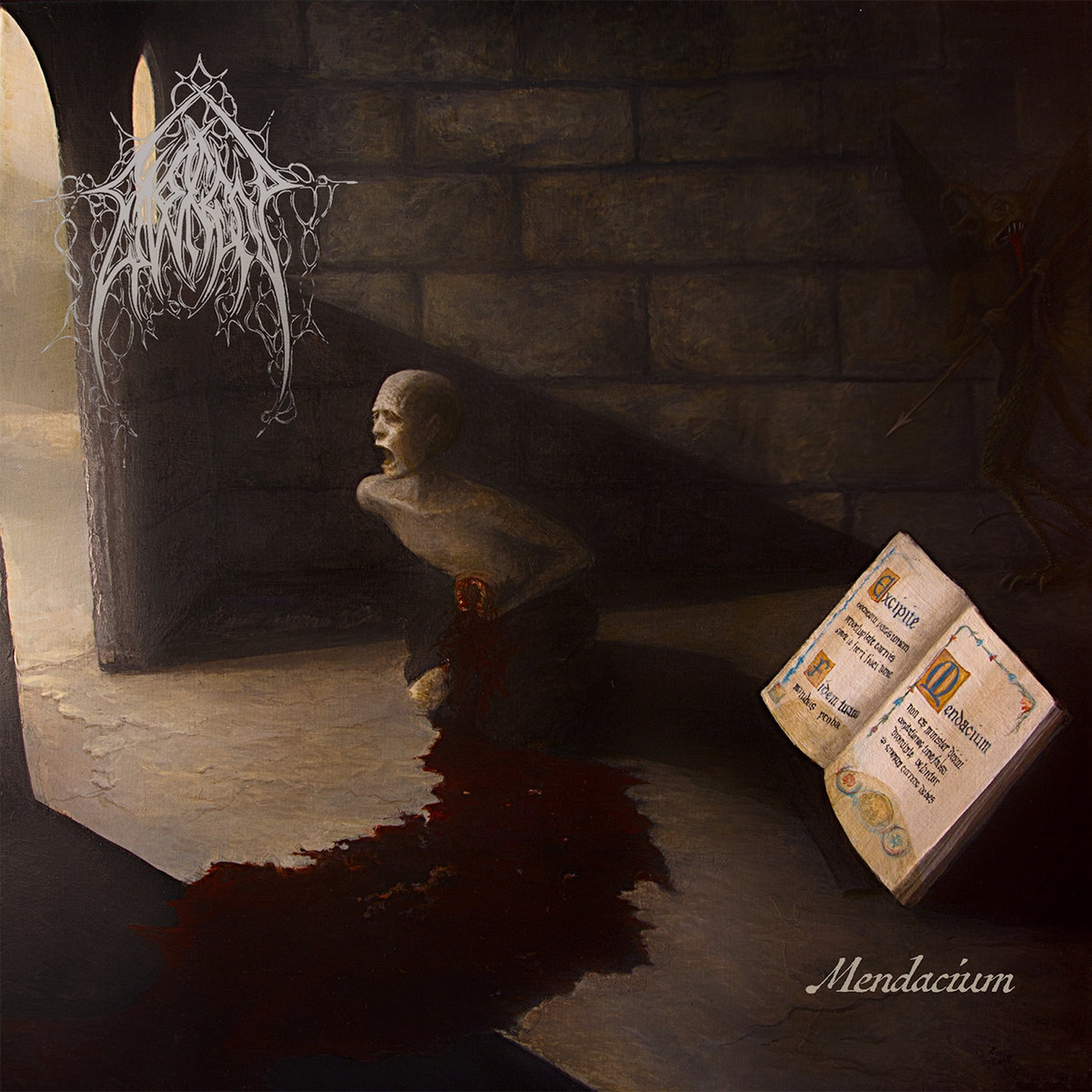
With Mendacium, Evoken not only reopen the gates to a soundscape in which time, space, and consciousness themselves begin to erode, they also reclaim their former strength without exposing themselves as a self-copy of their own golden age. The album evokes the gradual psychological dissolution of a Benedictine monk in the 14th century (yes, roughly the era of Eco’s The Name of the Rose), trapped in the solitude of his cell, afflicted by illness and insomnia. Between prayer and delirium unfolds a mental disintegration that can be read not merely as an individual tragedy, but as an existential meditation on perception, delusion, truth, and deceit — mendacium in its purest form.
Evoken choose a musical language reminiscent of their masterworks Quietus (2001) and Antithesis of Light (2005) — that phase in which the band understood funeral doom as a metaphysical medium. Yet Mendacium is no simple return (or, worse, self-imitation); it is a conscious re-engagement with their own history. It is a controlled asphyxiation, where every layer of sound is both an attempt and a failure — an attempt to impose order upon the chaos of one’s own perception.
Musically, the conceptual focus remains tangible: while Quietus moved within sacred, almost transcendent spaces and Antithesis of Light rendered emptiness and horror as cosmic truths, Mendacium retreats radically into the intimacy of a chamber piece, at times even a private cinema of the mind. The world is no longer vast but claustrophobic — a heterotopic cell of separation from the collective, a real and imaginary space where the echo of one’s own breath turns hallucinatory, erasing the boundary between perception and reality. Evoken’s Funeral Doom here ceases to be cosmic vastness; it becomes an acoustic folding. The space does not resonate — it closes in and loses itself.
Histoire de la folie
In light of Michel Foucault’s Histoire de la folie, Mendacium may be read as a musical reflection of that fundamental act of exclusion by which society defines itself as rational — by designating madness as its exterior. To define madness as “outside” is to elevate oneself as sane, normal, and thus superior to the irrational. The pre-Enlightenment monk embodies the subject who, standing at the limits of his own rationality, still seeks to interpret his disintegration as divine trial — assigning transcendental meaning to his delirium in order to preserve the illusion of his own dignity, until the divine itself is unmasked as the voice of his insanity. His cell becomes a heterotopia: another space that exists both within and beyond the social order. At first it appears as a place of divine contact; then it becomes a chamber of separation — the last refuge where madness retains the right to exist. Like Foucault’s plague-ships, this space drifts not across the sea, but through the inner oceans of consciousness, from one lucid instant of self-recognition to the next.
Evoken articulate this state with formidable consistency. Deep, unyielding guitar lines grind against resonant drones, while synthesizers seep like cold light through cracks in the wall. The growls are not a voice but the reverberation of a consciousness that no longer knows itself. In rare moments when the drums briefly push forward, as if to reimpose direction, the collapse of rhythm itself becomes palpable: movement folding in upon itself.
The production — clear but never sterile — leaves ample room for the indeterminate. The edges blur; frequencies overlap; Mendacium sounds like a score of doubt. The fact that Evoken have pared back the melodic ornamentation that characterized their most recent work is a strength: madness here is not staged — it is endured.
Apocalypse of the Self
What Mendacium accomplishes within the band’s discography is an intimacy that nonetheless resonates with Quietus and Antithesis of Light. The lyrical concept opens into a generalizable space of identification. After having attempted to sonically capture the Great War, Evoken now describe a collapse within. Listening becomes the act of thinking itself — until thought and sound are indistinguishable. The monk, wrestling with truth in his cell, becomes the metaphor of the modern subject:
Enclosed within the hermetic logic of reason, which can recognize itself only through madness.
Thus Mendacium stands firmly in the lineage of Evoken’s greatest works. Where Antithesis of Light, oscillating between the motifs of Gothic Horror (Shelley, Lovecraft) and nascent postmodernism (Kafka), brought metaphysical nihilism to its peak, Mendacium renders the microscopic apocalypse of the self. No end of the world — an inward melting.
In the end, a faint resonance remains, an almost inaudible pulse — as if the album itself were breathing. Perhaps that is the final deception: that even madness can still produce a sound reminding us that the world exists.
Evoken’s finest release since 2005
Truth is: Judging this record is not easy for me. I’ve always struggled with Evoken — yes. I recognize their strength and significance. And I revere Antithesis of Light, and, by that measure, it will likely remain unsurpassed. But I’ll venture this far:
Mendacium is Evoken’s finest release since that groundbreaking work, their best album in twenty years — a triumphant return to form and, without question, in many many list it will get one of the finest funeral-doom albums of 2025. Rightful So.